A few weeks ago, I wrote about a project involving Denver traffic accidents- where they happen, why they happen, and the typical conditions in which they occur. That yielded some interesting insights, including accident hotspots around the city, safer areas to drive, safer times to drive, and more.
I had so much fun learning about the city through that lens that I decided to do another analysis, this time involving crime in Denver from 2018 to 2023. What I found will blow you away.
Probably not. But still, if you live in or around Denver, you can learn some interesting insights, perhaps even some that guide future behavior.
Before diving into the results I found, let’s build the anticipation with some backstory.
Denver is the 20th largest city in the US. According to the US Census Bureau, in 2022 the city proper had about 713,000 residents, and the metro area boasted a population of 2.9 million. From 2000 to 2020, the city saw a healthy growth rate, going from 555,000 at the turn of the millennium, to a peak of 735,000 in 2020.
Yes, you did the math right- the city’s population has decreased in the last few years. This will become more interesting in a few moments.
Let’s start our Denver Crime Story with a nice map.
Take Home #1: There are 78 neighborhoods in Denver. Most of the crime is localized to just a few of them.

What are we looking at here? This is a map of all neighborhoods in Denver, with the darker colors reflecting a higher “danger score.” That is a derivation I created which is simply a composite score of crime frequency and the number of victims per crime in a given area over the 5 years.
The darkest splotch near the city center is Five Points- our #1 most dangerous neighborhood! Congrats to Five Points, I’m sure it worked hard to earn that title. Just south of Five Points is the Central Business District (CBD) and Capital Hill, also darker blue.
In the northeast corner, we see a few more dark areas- Central Park (I used to live there) and DIA (yes, the airport). Together, these neighborhoods round out the top 5.
For those of you looking to move in- or within- the city, consider other areas.
Okay, so you’ve told me where the crime “hotspots” are. What about the relatively quiet areas?
Check out this graph- it shows our top 10 safest neighborhoods.
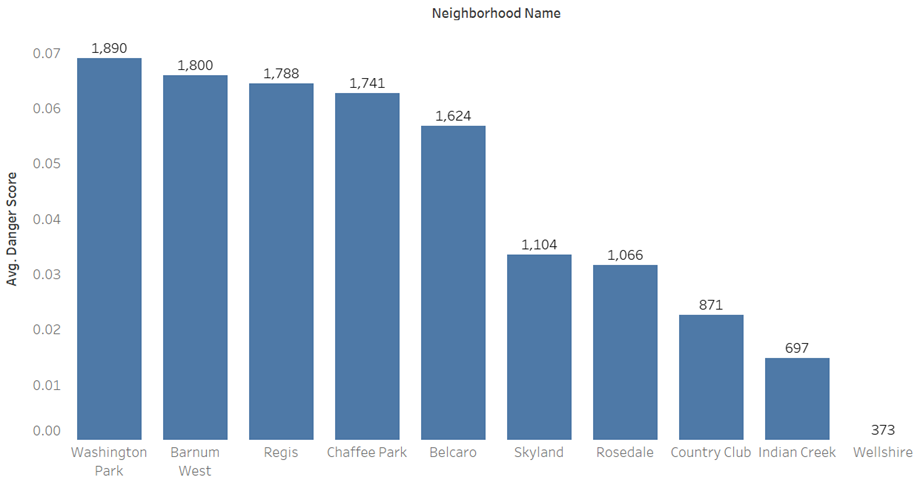
With the data collection period spanning about 2100 days, we can take the total number of crimes at the top of each bar, divide by 2100, and see that each neighborhood saw less than one crime per day.
Quick spotlight on Wellshire- holy shit! Wellshire boasts a 1 crime per week frequency- far and away the lowest relative to all other neighborhoods. A quick Google search told me the internet knows about this- multiple links led to articles about how safe it is, private golf tournaments, and weddings. So that’s why it’s so safe: Americans love their weddings and their golf tourneys.
Take home #2: Crime in Denver has been increasing over time.

This graph shows monthly crime rates from January 2018 to September 2023. Do you notice any general trends? Oh yeah- crime is going up! More crime is bad, right?
Right. But the question is…why? Let me point out one inflection point: from early 2018 to early 2020, there is a seasonal pattern taking place, but overall there isn’t an upward trend. But then, somewhere around March 2020, the rate of crime ticks up and continues to rise.
Oh great, yet another ramification of COVID-19. But with something as highly complex and multifactorial as city crime, there may be other factors at play. After all, the population has gone down somewhat, yet we’re seeing an uptick. What gives?
Before I get into why I think this is happening, I want to share more data first. Then, I’ll put my speculation cap on.
Take home #3: The type of Crime Denver gets isn’t that bad.
Well, crime is crime, but still. Let me show you what I mean.
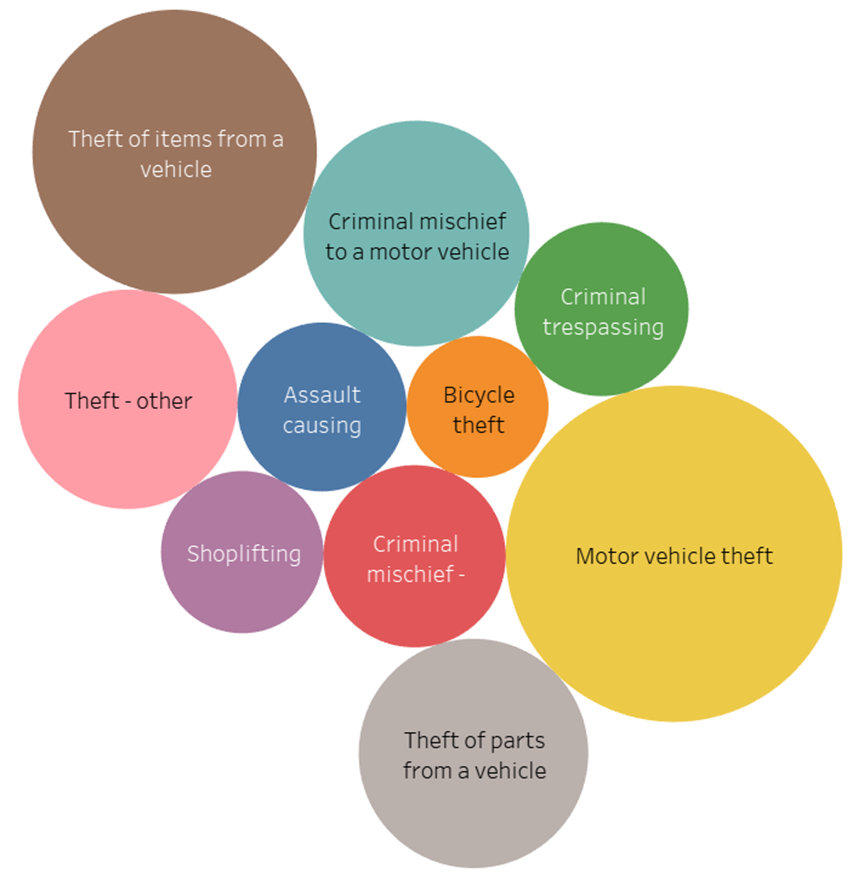
This shows the top 10 most common types of crime in the city. The bigger the circle, the more often it happens. Do you notice any trends? Theft is a common theme.
7 out of the top 10 involve theft. What does this tell us? One, it tells us that a lot of instances of crime are passive; meaning, it doesn’t directly involve one individual doing something to another individual.
Two, there isn’t as much violence as you think. The smaller blue dot in the middle is “assault causing minor bodily injury” which isn’t nearly as consequential as “aggravated assault” or “assault causing serious bodily injury.”
Does the rise of remote work- a direct consequence of COVID- explain most of the uptick in crime rates? More people working at home = more parked cars on city streets = more fresh opportunities for the crime-doers. That’s one possible line of thinking.
While getting stuff stolen from you sucks (I have a friend whose car was stolen from him a few years back), it’s better than some of the other, more unsavory alternatives.
Okay John, wrap this up in a neat little bow from me. What should I take away from this?
Final take-home: Understanding crime is hard. But we’ve learned some things.
Trying to understand the nature of a complex, multivariate phenomenon like crime is a bold undertaking. A city like Denver is a giant bowl of soup, overflowing with the different ingredients of society.
In that soup, you have different social classes, demographic backgrounds, and ideologies. Against this backdrop of society you have an equally complex, misunderstood, and moody system that is the Denver climate; subtly shaping our behaviors with the changing of the weather.
And here I come, swopping in with my powers of analysis, deduction, and curiosity, trying to wield those tools like a weapon of understanding. While there is still vastly more to learn, we’ve come a long way already.
Let’s recap those points, so I can retire this post and study up for my fantasy football draft. Here we go:
- Neighborhoods like Five Points, CBD, and Capital Hill are hotspots for crime.
- Neighborhoods like Wellshire, Washington Park, and Barnum West are chill. And safe.
- Crime has been increasing over the last 5 years, and COVID-19 seems to be the biggest driver. (As to why, more work needs to be done).
- The crime we get in Denver isn’t that bad, so let’s all just relax.
- Weather patterns dictate crime rates: there’s more crime in the summer, and less in the winter.
- LOCK YOUR CARS!!!
That’s all for now. If you made it this far, you’re my favorite. I will see you in the next post (which will surely be my best one yet).
 John Phillips